
- Home
- Products ›
- Fasst Seal Brand
- - Door Seals
- - Electrical Outlet
- - Pipe Gasket
- Seal-N-Kill Brand
- - Tape Roll
- - Push Plate
- - Custom
- Features
- Technology ›
- Testing ›
- Publications
- Contact

University Testing of FASST SealsTM was performed by Dr. Gunter Muller at the Hebrew University, Jerusalem, Israel. The testing confirmed high repellency efficiency for Bed Bugs, American and German Cockroaches, Pharoah Ants, Carpenter Ants, Meal Beetles, Crickets, Mice and Rats. The impregnated polymer has also demonstrated that it inhibits rodents from gnawing in search of food.
For more studies and reports, please contact us.
Repellency rates for insects exposed to Active seals flat on the ground varied from 77.27% to 94.79% while vertical seals with adjusted gaps for the tested insects showed repellency rates from 83.54% to 93.67%. All results for the tested insects are highly significant.
It is noteworthy that crickets and roaches were frequently checking out the seals with their antenna before crossing. If exposed to Active seals they often moved parallel to the strips while repeatedly probing with their antenna. The few specimens that crossed flat Active seals did this in a hesitating way and often with visible extended legs. A similar way of behavior and hesitation was observed with insects crawling under the vertical seals (without visible extension of legs).
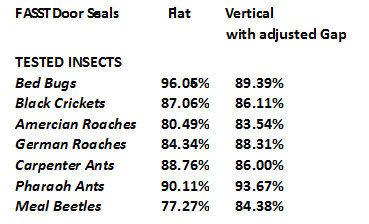
It is important to note that in the field, the seals will be flush with the floor and provide a sealed physical barrier. In addition, the insects will be able to move in an open environment therefore the repellency rate is expected to be even higher.
House Mice: Twenty mice (20/24) entered the Control shelter. Four (4/24) mice entered the Active seal shelter.
Mice Repellency Rate 80%
Rats: 21 times (21/24) a rat entered a house with a Control seal and 3 times (3/24) entered into a house with an Active seal.
Rat Repellency Rate 85.72%
It is worthwhile mentioning that when rodents were examining the shelter with the Active seal they were often only sticking in their head and then, most of the time, immediately retreating. When examining the Control seal shelter the rodents were entering with their full body often without hesitation. We additionally observed that rodents that entered the Control seal shelter stayed, compared to rodents that entered the Active seal shelter, staying only for seconds.
In the two experiments in which rodents had a choice between two tubes loaded with food, one Active tube and one Control tube, they were in all cases gnawing through the Control tubes and feeding on the peanut butter (24 mice and 24 rats) without touching the Active tubes (no traces of gnawing).
When rodents were only exposed to the Active tubes, a few rodents superficially gnawed on the tubes without reaching the food. This type of gnawing was observed with 2 rats (2/24) and 5 mice (5/24).
The tested Active FASST SealsTM, regardless of positioning, whether laying flat or vertical (with a crawl space gap), repelled highly significantly all the tested insects with percentages ranging from 77.27% to 96.05% . The tested seals were aged by exposure in ambient environment for 4 months prior to testing. Accordingly, the efficacy of the product can be claimed for at least 4 months.
If given a choice of suitable shelters most tested mice and rats avoided close physical contact to Active FASST SealsTM. It can therefore be concluded that the FASST SealsTM are a valid rodent repellent barrier.
If mice and rats had an alternative food source the Active impregnated polymer tubing provided complete protection from gnawing. With Active tubes only, superficial gnawing was observed in a few cases. The unprotected Control tubes were, at the same time, completely destroyed. It can therefore be concluded that the active ingredients in the polymer kept the rodents from damaging the tubes. The results of both experiments safely demonstrated that both fragrance and taste of the actives are repellent.
The tested tubing was aged by exposure in ambient environment for 4 months prior to testing. Accordingly, the product efficacy can be claimed to inhibit rodent gnawing for at least this time period.
Dr. Gunter C. Muller
Coordinator of the study
Adult Bed Bugs and Adult Pharaoh Ants, Juvenile Black Crickets, Juvenile American Cockroaches, Juvenile German Cockroaches (juveniles 2-3 mm).
Repellency rates for insects exposed to Active cover inserts and Control cover inserts varied from 91.78% to 97.33%. All results for the tested insects are statistically significant.
Repellency rates for insects inserted into electrical boxes with Active cover inserts and Control cover inserts varied from 92.85% to 100%. All results for the tested insects are statistically significant. In the trials with impregnated inserts most of the insects that did not exit into the arena left the electrical box and accumulated in the plastic box at the backside. In the trials with control insects the bulk of the insects that did not exit into the arena remained inside the electrical box.
Trial I: Release of insects inside common Arena "outside-in" and
Trial II: Release of insects inside Electrical Box "inside-out"
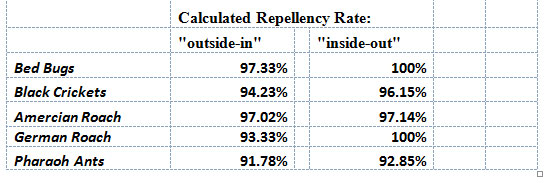
The tested Active FASST Electrical Plug Cover Inserts repelled highly significantly all the tested insects with percentages ranging from 91.78% in the plate cover repellency test to 100% in the no choice electrical box insertion test. The tested inserts were aged by exposure in ambient environment for 4 months prior to testing. Accordingly, the efficacy of the product can be claimed for at least 4 months.
The explanation of the fact that in Insect Repellency Trial II most of the insects that did not exit through the front plate into the arena accumulated in the backside of the plastic electrical box in the case of the Control inserts and left the electrical boxes in the case of the Active inserts is that the insects on one hand did not want to cross the impregnated inserts but on the other hand they wanted to escape the vapor pressure that built up in the electrical box and hence they tried to leave through the backside. In practical applications this observation would indicate that the repellent vapor would keep insects from initially entering the electrical box due to a build-up in repellent vapor.
During practical application in the field the Inserts are expected to work both as a physical as well as a repellent barrier providing high insect barrier and repellency efficacy. The experimental test materials and methods were designed to minimize the physical barrier contribution of the Insert. As the Inserts provided a significantly high repellency effect it was deemed to be unnecessary to also test the Inserts in the light switch covers as similar results are expected.
Dr. Gunter C. Muller
Coordinator of the study
When comparing the number of insects entering the two Treated Pipe Gasket side chambers to the number of insects entering the two Untreated Pipe Gaskets side chambers the Treated Pipe Gasket repellency rates varied from 92.31% to 96.97%. All results for the tested insects are highly significant.
Bed Bugs 96.43%
Black Crickets 92.31%
American Roach 96.84%
German Roach 94.79%
Pharoah Ants 96.97%
Meal Beetles 93.51%
One mouse passed through the Treated Pipe Gasket while 19 mice passed through the Untreated Pipe Gasket. Mice were exploring the chamber and made an entry decision relatively quickly within a maximum of 5 minutes. Repellency rate for mice was 95% which was highly significant.
The Treated FASST Pipe Gasket repelled highly significantly all the tested insects with percentages ranging from 92.31% to 96.97%. The mice repellency rate was 95% and highly significant. This trial confirms results which were obtained in the Door Seals Study. The tested pipe gaskets were aged by exposure in ambient environment for 4 months prior to testing. Accordingly, the efficacy of the product can be claimed for at least 4 months.
The experimental methods were designed to minimize the physical barrier contribution of the Pipe Gaskets and obtain test data to confirm insect and mice repellency product features and claims. During practical application in the field the FASST Pipe Gaskets are expected to work both as a physical as well as a repellent barrier providing high efficacy. The slit in the Pipe Gasket facilitates placement onto existing piping and the gasket cutout grooves make it easy to size the gasket according to the pipe diameter.
1: Department of Parasitology, Kuvin Centre for the Study of Infectious and Tropical Diseases, The Hebrew University - Hadassah-Medical School, Jerusalem, ISRAEL
2: Department of Human Biology, Faculty of Natural Sciences, Haifa University, Haifa, ISRAEL
Cracks, crevices and openings around water pipes and drain pipes running through walls are potential pathways for insects and mice in their search for food, shelter and warmth. Water and drain pipes connecting sinks, toilets, water heaters, showers and baths are potential pathways for insects and mice to enable them to move from basements to bathrooms and from apartment to apartment.
FASST Pipe Gaskets are impregnated with EPA 25b Exempt Active Ingredients, essential oils which are known in the literature to repel a broad range of insects. The Pipe Gaskets are easily installed and replaceable on a scheduled basis to provide ongoing repellency and barrier protection.
Treated Pipe Gaskets were aged for 4 months under ambient conditions prior to testing for repellency and to confirm the 4 month residual activity claim. Untreated Pipe Gaskets were provided to serve as experimental controls. The Untreated Pipe Gaskets tested were the same material and dimensions as the Treated Pipe Gaskets but were not impregnated with active ingredients.
While the Pipe Gaskets can serve as both a physical and a repellent barrier, it is the object of the experiments to confirm the repellency effect. Therefore, the crevices that were made in the wall board around the PVC water pipes were of sufficient size to permit the insects and the mice entry. Under normal installation and operating conditions the physical barrier feature of the FASST Pipe Gaskets combined with repellency feature would provide effective insect and mice exclusion. Exclusion of insects has become an essential part of IPM.
Object of Experiment under controlled laboratory conditions:
a) To test the repellency efficiency of FASST Pipe Gaskets on insects entering crevices around water pipe.
b) To test the repellency efficiency of FASST Pipe Gaskets on mice entering crevices around water pipe.
Products Tested:
FASST Pipe Gaskets impregnated with EPA Exempt 25b Active ingredients. The Pipe Gaskets supplied were 10.75 cm diameter with center hole cut outs of 1.25 cm. The gaskets have a slit from the outside edge to the inside center hole. Both Treated and Untreated Pipe Gaskets were of the same dimensions and polymer material, packed in re-sealable vapor bags. Pipe Gaskets tested were unpacked and aged in ambient room conditions for four months prior to testing.
Products were provided by FASST Products, LLC 72 Allen Road, Rockville Centre, NY 11570.
Test Period: December 2015
Test Location: Faculty of Natural Science Haifa University, Haifa, Israel
Six experimental test arenas were constructed with dimensions: 20cm W x 64 cm L x 15 cm H. The arenas were divided into 3 equal sized chambers by 2 walls (2 cm wall board) spaced 20 cm apart. PVC water pipe (1.25 cm diameter) was placed running through the holes cut into the walls. The pipe ends were capped. The holes in the walls were sized to be larger than the water pipe leaving an entry gap of 0.5 cm between the wall and the pipe. Tangle-Foot Sticky Coating glue (The TangleFoot Company, Grand Rapids, MI) was applied to the floor and 3 exterior walls in the two outside arena chambers to trap insects that moved into the outside chambers. A separate wire mesh cover was used to cover each of the experimental arenas. The Pipe Gaskets were placed onto the PVC pipe, in the two outside chambers, positioned 0.5 cm away from the wall.
The insects were gently inserted into the center chamber by first placing them into a shallow box and covered with a paperboard sheet. The shallow box was then placed into the center of the chamber upside down and the cover removed. The upside down box was then removed after five minutes permitting the insects time to de-stress. The insects could then move freely about the center chamber with a dual choice of either staying in the center chamber or moving into either of the two side chambers thorough the gap between the pipes and the walls. The test arenas were observed after 4 hours and the number of insects remaining in the center chamber and the number of insects transiting into the side chambers was recorded.
Experiments for each insect species were run with cohorts of 10 specimens with 10 repetitions for the Treated Pipe Gaskets and 10 repetitions for the Untreated Pipe Gaskets (1200 insects in total). For each repetition the two Pipe Gaskets in each arena were either Treated or Untreated. Each insect species experiment was conducted with fresh insects. Treated Pipe Gaskets and Untreated Pipe Gasket arenas were tested alternatively and after each experiment the arenas were cleared of all insects. Repellency was calculated by comparing the number of insects crossing the Treated Pipe Gasket with the number of insects crossing the Untreated Pipe Gasket.
Insects Tested: Adult Bed Bugs, Adult Pharaoh Ants, Juvenile Black Crickets, Adult American Cockroaches, Adult German Cockroaches, and Adult Meal Beetles
The mice test arena was constructed with dimensions; 90 cm W x 94 cm L x 30 cm H. The arena was divided into 3 equal sized chambers by 2 walls (2 cm wall board) positioned 30 cm apart. PVC water pipe (1.25 cm diameter) was placed running through holes cut into the wall board. The pipes were capped. The holes in the walls were sized to be larger than the water pipe leaving a gap of 1.5 cm between the pipe and the wall. In one side chamber a Treated Pipe Gasket was attached onto the PVC pipe at a distance of 1.5 cm from the wall and in the other side chamber an Untreated Pipe Gasket was also attached onto the PVC pipe at 1.5 cm from the wall. Wire mesh was used to cover the experimental arena.
A mouse was placed into the center chamber of the arena and observed until moving into one of the two side chambers. The mice had three choices; 1) remain in the center chamber, 2) move past the Treated Pipe Gasket into the side chamber, or 3) move past an Untreated Pipe Gasket into the other side chamber. In total 20 repetitions were run with fresh mice. The test arena was rotated 180 degrees after each repetition to eliminate light or other potential bias. The number of mice entering the Treated Gasket Chamber or the Untreated Gasket Chamber was recorded.
Results
When comparing the number of insects entering the two Treated Pipe Gasket side chambers to the number of insects entering the two Untreated Pipe Gaskets side chambers the Treated Pipe Gasket repellency rates varied from 92.31% to 96.97%. All results for the tested insects are highly significant.
Bed Bugs 96.43%
Black Crickets 92.31%
American Roach 96.84%
German Roach 94.79%
Pharoah Ants 96.97%
Meal Beetles 93.51%
One mouse passed through the Treated Pipe Gasket while 19 mice passed through the Untreated Pipe Gasket. Mice were exploring the chamber and made an entry decision relatively quickly within a maximum of 5 minutes. Repellency rate for mice was 95% which was highly significant.
The Treated FASST Pipe Gasket repelled highly significantly all the tested insects with percentages ranging from 92.31% to 96.97%. The mice repellency rate was 95% and highly significant. This trial confirms results which were obtained in the Door Seals Study. The tested pipe gaskets were aged by exposure in ambient environment for 4 months prior to testing. Accordingly, the efficacy of the product can be claimed for at least 4 months.
The experimental methods were designed to minimize the physical barrier contribution of the Pipe Gaskets and obtain test data to confirm insect and mice repellency product features and claims. During practical application in the field the FASST Pipe Gaskets are expected to work both as a physical as well as a repellent barrier providing high efficacy. The slit in the Pipe Gasket facilitates placement onto existing piping and the gasket cutout grooves make it easy to size the gasket according to the pipe diameter.
Dr. Gunter C. Muller
Coordinator of the study